
Why the thermometer compares the wrong number
A traditional sauna heats the room to roughly 150 to 195°F with a stove and stones, sometimes with steam poured over the rocks. An infrared sauna usually runs closer to 120 to 150°F. Read side by side, the traditional sauna looks far hotter.
But the two heat the body by different routes. A traditional sauna heats the air, and the air heats you. An infrared system sends radiant energy straight to the skin, so the body warms before the air does. The number on the wall reports the air. It says nothing about how much radiant energy is reaching the person on the bench.
The better questions are: what spectrum is the heat source producing, how intense is that energy where you sit, how far are you from it, how long is the session, and how well does the enclosure hold what the lamps deliver? Together those describe the thermal dose of an infrared sauna session.
What “full spectrum” really means
Infrared is divided into near, mid and far bands, but the labels are approximate boundaries, not biological dividing lines. Roughly: amber and orange light 550 to 620 nm, visible red 620 to 700 nm, near infrared 700 to 1,400 nm, mid infrared 1,400 to 3,000 nm, and longer infrared above 3,000 nm.
An incandescent tungsten filament does not switch on at one wavelength. It emits a broad, continuous spectrum that begins around 550 nm and runs through visible red into near, mid and longer infrared at the same time. An LED produces one or two narrow bands, and a far infrared panel emits mainly at the long end. So the honest question about any “full spectrum” sauna is not the label on the box. It is the measured output of the heat source.
Red light interacts mainly with the skin and the tissue just beneath it. Near infrared generally travels farther before it is absorbed, though how far depends on wavelength, tissue, pigmentation and dose. Chung and colleagues (2012, Annals of Biomedical Engineering) describe roughly 600 to 1,070 nm as the window in which light passes through tissue most readily, which is why that range dominates photobiomodulation research.
Thermal dose depends on more than wavelength
Two saunas with the same bulbs can deliver very different exposures. Three practical variables set the dose:
- Intensity. How much radiant energy reaches the body.
- Distance. Radiant intensity falls fast as you move away from the source. One bulb manufacturer’s broadband measurements show the curve: about 1,431 mW/cm² at 4 inches, 671 at 8 inches, 268 at 12 inches and 101 at 16 inches. Those figures are total output across visible and infrared wavelengths, heat included, not a therapeutic dose. Sauna Fix® users normally sit 18 to 30 inches from the bulbs, farther still.
- Time. How long the body is exposed.
A 130°F enclosure with a strong radiant source close to the body can deliver a substantial thermal exposure even though its air is far cooler than a 180°F traditional sauna. Judging a sauna by its maximum cabin temperature leaves most of that out.
The enclosure is part of the system
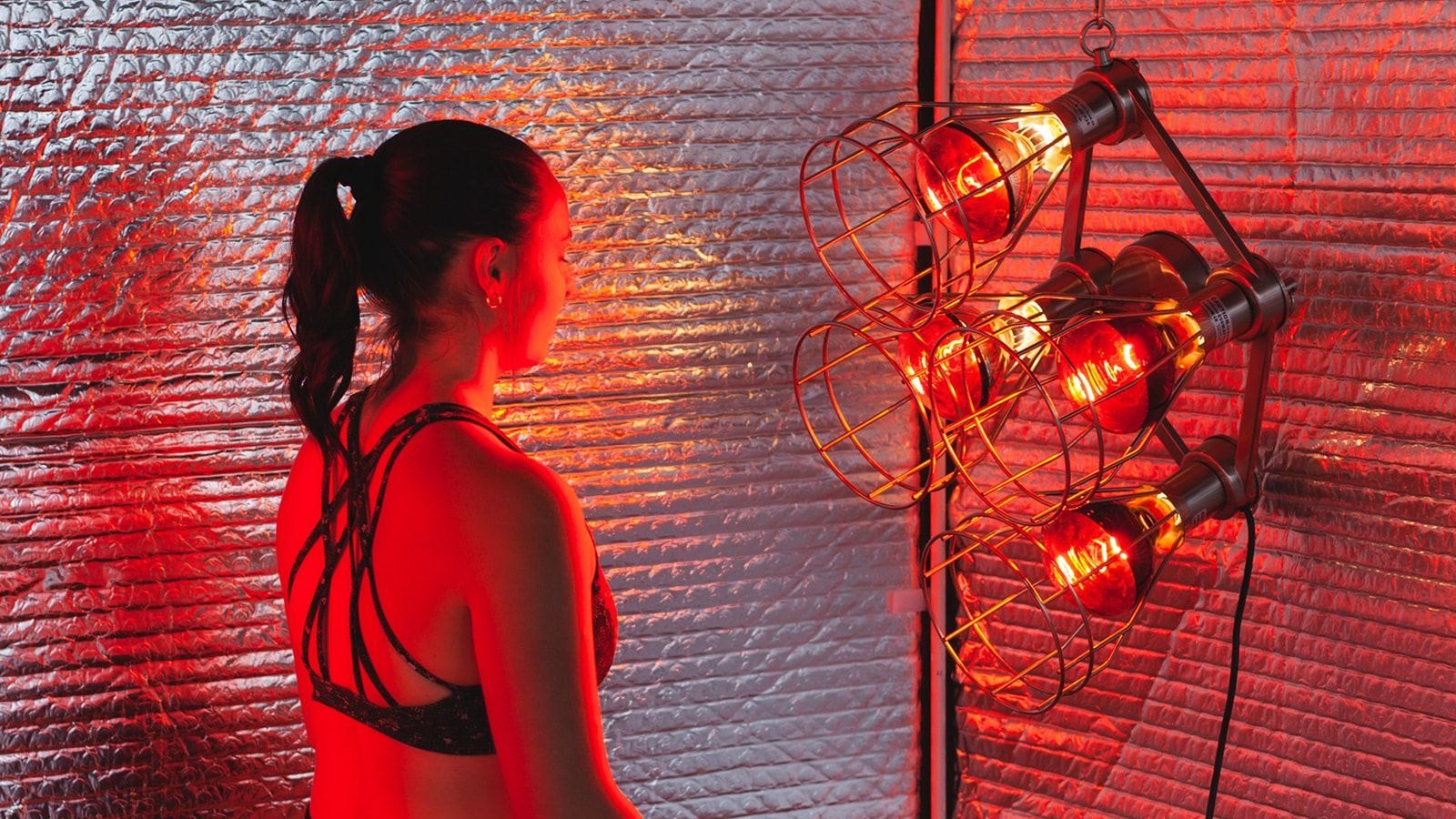
Once energy leaves the lamp it can reach you directly, reflect off the walls, soak into the wall material, warm the air, or escape through seams. The enclosure decides which. Insulation slows heat loss, and a reflective, low-emissivity lining sends radiant energy back into the occupied space instead of absorbing it. Reflection also preserves wavelength: a reflected near infrared photon is still near infrared.
That is why the same four bulbs in an open room and inside a heat-retaining tent are two different saunas. The Sauna Fix® radiant tent is rated at R-15 insulation with a lining rated to reflect up to 97 percent of incident radiant energy. A single four-bulb lamp brings it to about 140 to 145°F; a double lamp with eight bulbs reaches about 185°F. Same bulbs, different dose.
Comparing infrared and traditional saunas by dose
A traditional session relies on high air temperature, so sessions tend to be short because the environment becomes intensely hot. An infrared session uses lower air temperature and adds radiant energy from the heat source. Within “infrared” the exposures still differ: far infrared panel cabins surround the body with large heating surfaces at greater distances, while incandescent lamp systems place a concentrated source much closer. Reed and colleagues (2025, Journal of Applied Physiology) measured far infrared heating in the human forearm and reported an effective thermal penetration of about 2.4 cm, with deeper tissue warming by conduction inward from the skin.
So “infrared sauna” is not one standardized exposure, and the useful comparison is not 180°F versus 130°F. It is spectrum plus radiant intensity plus distance plus time plus enclosure temperature. For a wavelength-by-wavelength comparison, see near infrared versus far infrared saunas.
What the research reports
Studies on sauna use measure body and skin temperature, heart rate, sweating and circulation-related markers under controlled heat. Hussain and Cohen (2018), in a systematic review in Evidence-Based Complementary and Alternative Medicine, summarized the physiological responses reported across traditional and infrared sauna studies and noted how widely the protocols vary. Imamura and colleagues (2001, Journal of the American College of Cardiology) reported flow-mediated dilation measurements before and after a two-week infrared thermal protocol at 140°F in a small group of adults with coronary risk factors.
These are reports on specific protocols, not a promise about any sauna. Temperatures, heater designs, distances, session lengths and participants differ from study to study, which is one more reason to think in terms of dose. Research describing one heater and enclosure cannot tell you the dose delivered by a different one. Nothing here is a prescription; sauna use is not intended to diagnose, treat, cure or prevent any disease.
Safety and realistic expectations
More heat is not automatically better. Sauna exposure increases sweating and asks more of the body’s temperature regulation, so hydrate, start with shorter sessions at a lower setting, and let comfort decide how far to go. Stop at dizziness, nausea, unusual weakness or real discomfort. Anyone who is pregnant, or who takes medication affecting hydration, circulation or heat tolerance, should talk with a healthcare professional first.
Above all, do not judge an infrared sauna by the cabin thermometer. Look at the spectrum of the heat source, the radiant intensity where you sit, your distance from the bulbs, the session length and how the enclosure holds heat. That is the difference between measuring room temperature and thinking in terms of thermal dose.
Creatrix Solutions designs and sells the Sauna Fix® near infrared sauna, an incandescent lamp-and-tent system built around these variables. This article is educational and is not medical advice.
Creatrix Solutions
contact@creatrixsolutions.com
+1-866-686-5605
214 E Albany Avenue
Building E101
Kennewick
WA
99336
United States


