
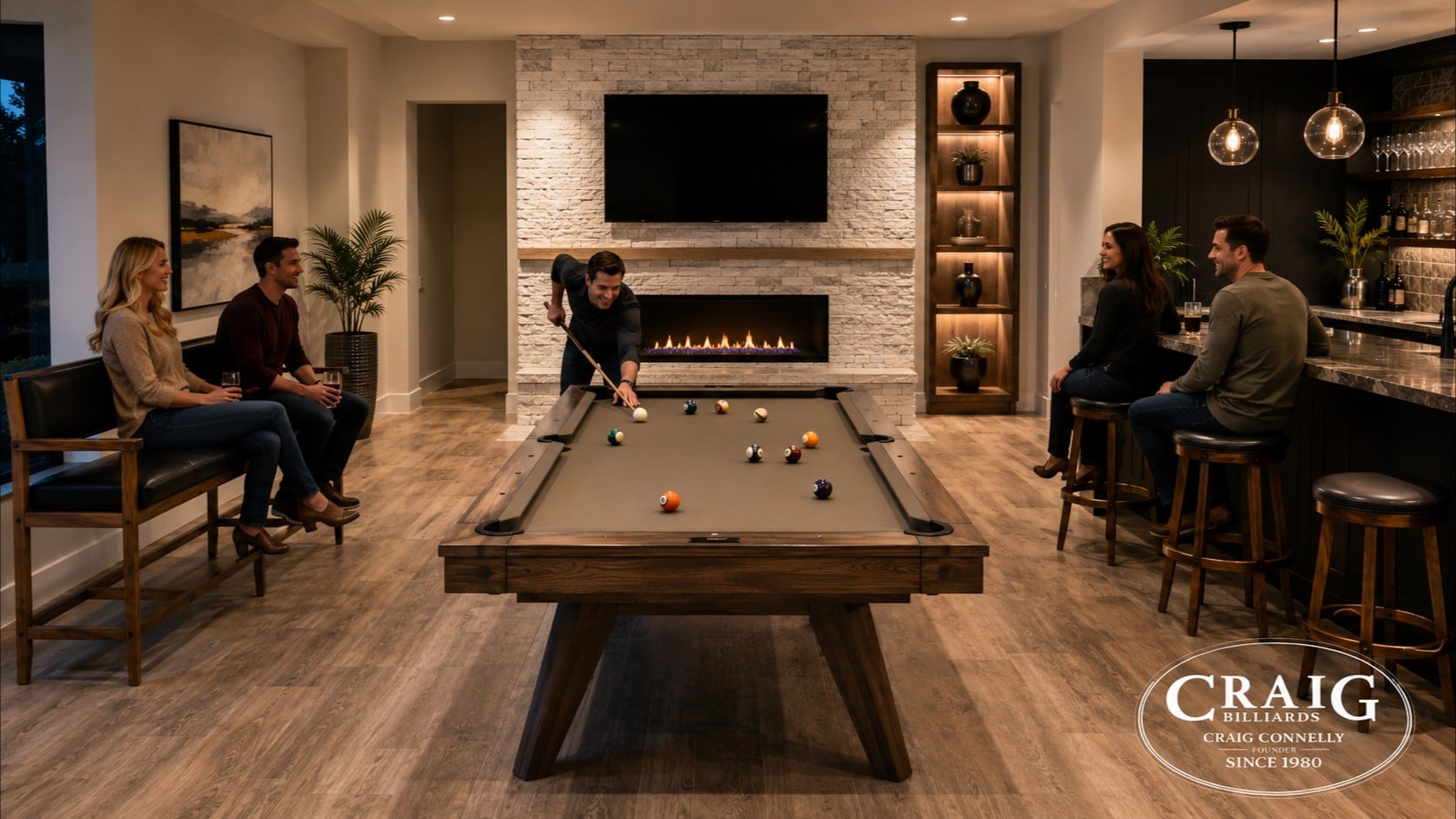
The Game Room Is Back: Why Homeowners Are Returning to Screen-Free Entertainment in 2026
For years, home entertainment became increasingly centered on screens. Bigger televisions, home theaters, streaming services, gaming consoles, tablets, and smartphones changed how people spent time at home. Those technologies are not disappearing, but a different kind of entertainment space is gaining momentum in 2026.
The game room is back.
Homeowners are once again making room for pool tables, shuffleboard tables, foosball, darts, card games, bars, and other forms of entertainment that require people to participate rather than simply watch. The shift is showing up in search behavior, home-design coverage, and the way modern entertainment spaces are being planned.
Houzz’s 2026 search data has shown sharp increases in interest for rooms dedicated to analog entertainment, with the platform describing the movement as a desire for “screen-free enjoyment.” Architectural Digest has separately reported that entertaining spaces are becoming more experiential and that game tables are returning as meaningful elements of home interiors. Forbes has highlighted modern basement designs that combine billiards and game areas with media lounges, bars, flexible seating, and multifunctional furniture.
For CRAIG BILLIARDS, this is not a sudden discovery. Craig Connelly has spent decades around billiards, pool tables, game rooms, and the customers who build them. What has changed is the broader design conversation. The pool table is no longer being treated only as recreation equipment placed in a spare basement corner. Increasingly, it is part of the way an entire room is designed, furnished, and used.
Why Screen-Free Entertainment Is Finding an Audience
Modern life involves an extraordinary amount of screen time. Work happens on laptops. Communication happens on phones. Entertainment often means streaming, gaming, or scrolling. Even many social experiences are mediated through devices.
That makes physical, shared activities feel different.
A game of pool asks everyone in the room to pay attention to the same thing. Players stand up, move around the table, talk between shots, watch one another play, and remain involved even when it is not their turn. Shuffleboard creates a similar rhythm. Foosball is immediate and energetic. Darts can turn an unused wall into a place for casual competition.
These activities do not require a digital detox or a rejection of technology. They simply create another option.
That distinction matters because the best modern game rooms are not necessarily screen-free in the literal sense. Many include televisions, sound systems, sports viewing, streaming, and gaming. The difference is that screens are no longer the only attraction.
A well-designed game room gives people a reason to interact with the space and with one another.
The Pool Table Is Becoming Furniture Again
One of the most interesting parts of the current game-room revival is the role of design.
A pool table has always been a large object. That alone gives it visual importance. In the past, however, many recreational rooms treated the table almost like equipment: install it in the available space, hang a light above it, place a few stools nearby, and consider the room finished.
That approach is changing.
Many of today’s pool tables are designed to function as substantial pieces of furniture. Traditional hardwood tables can anchor classic interiors. Modern models use cleaner lines, exposed structures, mixed materials, metal detailing, or minimalist silhouettes. Rustic tables fit homes with natural wood, stone, or industrial finishes. Custom options allow the table to coordinate with flooring, cabinetry, bars, wall treatments, and other furniture.
At CRAIG BILLIARDS, that design relationship has long been part of the conversation. Selecting a table is not only about deciding between seven-, eight-, or nine-foot dimensions. Wood species, finish, cloth color, pockets, legs, rail profiles, hardware, and surrounding décor can all influence the finished room.
A table that fits the architecture can make a game room feel intentional rather than assembled.
That matters even more in open-concept entertainment spaces, luxury basements, large great rooms, detached guest structures, and dedicated recreation wings where the billiards area may be visible from multiple parts of the home.
Room Planning Matters More Than Table Size Alone
The renewed attention on game rooms is also encouraging homeowners to think more carefully about space planning.
A pool table has to fit the room, but the room also has to fit the game.
That means measuring for cue clearance, not simply checking whether the table itself fits between the walls. Furniture placement matters. So do doors, columns, fireplaces, cabinets, stairways, bars, and traffic paths. Lighting should illuminate the playing surface without creating uncomfortable glare or interfering with movement.
The most attractive room can still become frustrating if a cue repeatedly hits a wall or nearby piece of furniture.
For that reason, table selection should begin with the space. An eight-foot table may be ideal in one room, while a seven-foot table creates a much better playing experience in another. Larger tournament-size tables need additional clearance and can influence every other design decision in the room.
This is one of the areas where working with a billiards specialist can prevent expensive mistakes. A pool table is not a piece of furniture that can simply be pushed six inches to the left after installation. Proper placement, assembly, leveling, and playing clearance should be considered before the room is complete.
The Modern Game Room Is Multifunctional
The old stereotype of the game room was simple: a basement, a pool table, perhaps a television, and whatever furniture no longer fit upstairs.
The 2026 version is much more deliberate.
Modern entertainment spaces often combine several uses. A billiards area may share the room with a wet bar, wine storage, lounge seating, a media wall, a card table, arcade games, shuffleboard, darts, or a home theater. Built-in cabinetry can keep cues, balls, accessories, board games, and serving pieces organized. Flexible seating allows the room to shift from casual family use to larger gatherings.
Forbes’ coverage of modern basement design reflects this same approach. The goal is not to dedicate an entire floor to one activity. It is to create an entertainment environment that supports different activities throughout the day or evening.
That concept works beyond basements.
Bonus rooms can become compact game lounges. Large lofts can combine billiards with seating and media. Formal rooms that are rarely used can be converted into active spaces. Casitas and guest houses can become entertainment retreats. Covered patios and pool houses can incorporate outdoor-rated billiards tables designed for exterior conditions.
The common thread is function. Homeowners are looking for rooms that actually get used.
Billiards Has an Advantage in a Fast-Changing Entertainment Market
Home entertainment technology changes quickly. Televisions improve. Gaming systems are replaced. Streaming platforms come and go. Smart-home hardware evolves. Many devices feel outdated within only a few years.
A quality billiards table operates on a different timeline.
When properly built, installed, and maintained, a pool table can remain in a home for decades. Cloth can be replaced. Cushions can be serviced. A table can be disassembled and moved. In many cases, finishes and components can be restored or updated.
The game itself does not require a software update.
That durability gives billiards a particular appeal within the broader movement toward more intentional home entertainment. The table can be both a long-term furnishing and an activity that continues to work regardless of what happens to the technology around it.
There is also a generational quality to billiards that is difficult to reproduce digitally. Parents can teach children. Friends can play casually during a gathering. Serious players can practice for hours. Guests who have never played before can understand the basic objective within minutes.
The same table can support very different levels of involvement.
Luxury Game Rooms Are Becoming More Personal
Another reason the game room is returning is that homeowners are becoming more comfortable designing rooms around personal interests.
For a long time, residential design often prioritized broad resale appeal. Formal dining rooms, neutral layouts, and predictable room functions dominated many homes even when those spaces were rarely used.
Current design trends are giving more attention to how a home actually supports daily life.
For some households, that means a fitness room. For others, it means a wine room, golf simulator, craft studio, listening room, library, theater, or game room. The value is not only visual. It comes from creating a home that encourages the activities that matter to the people living there.
Billiards fits naturally into that idea because a table can be highly personalized.
Some buyers want a traditional table that feels permanent and architectural. Others prefer a contemporary design that looks closer to modern furniture. Some want a tournament-oriented playing experience. Others care more about the table’s relationship to the room. Custom tables can address both.
At CRAIG BILLIARDS, the goal has always been to match the table to the setting rather than treating every game room the same way.
A Game Room Can Encourage People to Stay in the Room
One of the simplest reasons for the game room’s return may also be the most important: it gives people something to do together.
A television can bring people into a room, but it often keeps attention pointed in one direction. Phones can put several people on the same sofa while each person occupies a different digital space.
A game table changes the orientation of the room.
People face one another. They move. They react. They talk. A match creates natural pauses for conversation, food, drinks, and spectators. Even guests who are not playing can remain involved.
That dynamic is one reason billiards has remained associated with social spaces for generations. Pool halls, clubs, bars, resorts, recreation rooms, and private homes have all used the table as a gathering point.
In a residential setting, the same principle applies. The table gives the room a purpose without dictating exactly how the evening has to unfold.
Building a Game Room That Lasts
The renewed popularity of game rooms will likely bring more products, more design ideas, and more inspiration into the market. That makes it even more important to distinguish between a room that photographs well and a room that functions well.
A successful billiards space starts with proper dimensions and the right table size. It should account for cue clearance, lighting, circulation, seating, flooring, storage, and the other activities that will share the room. The table itself should be selected with both play and design in mind.
Quality also matters.
Slate, frame construction, cabinet materials, cushions, cloth, leveling, installation, and serviceability all influence the playing experience and the long-term value of a table. Two tables that look similar in photographs can perform very differently once installed.
That is where decades of billiards experience remain valuable. Trends may bring new attention to the category, but the fundamentals of selecting, installing, and maintaining a pool table have not changed.
The Game Room Is Back for a Reason
The return of the game room is not simply a nostalgia cycle.
It reflects several larger shifts happening at the same time: interest in screen-free activities, more experiential home design, greater personalization, multifunctional entertainment spaces, and renewed appreciation for objects that can remain useful for decades.
Pool tables sit at the intersection of all of those ideas.
They are interactive without being digital. They can function as furniture while still serving a clear purpose. They work in traditional, contemporary, rustic, industrial, and highly customized interiors. They can anchor a dedicated billiards room or become one part of a larger entertainment environment.
Most importantly, they create a reason to gather.
After decades of home entertainment moving steadily toward individual screens, homeowners are rediscovering the appeal of standing around a table, talking between turns, competing face to face, and spending time in a room designed for participation.
For CRAIG BILLIARDS, that renewed interest feels less like a new trend than a return to something billiards has always done well: bring people together around the game.
Ready to start planning your own game room? Click here for more information about designing a modern game room
CRAIG BILLIARDS
Sales@CraigBilliards.com
+1 480 907 7600
15816 N Greenway Hayden Loop #400
Scottsdale
AZ
85260
United States


