Rising convenience culture, expanding franchise networks, and mobile-first food ordering reshape the QSR landscape in the Philippines
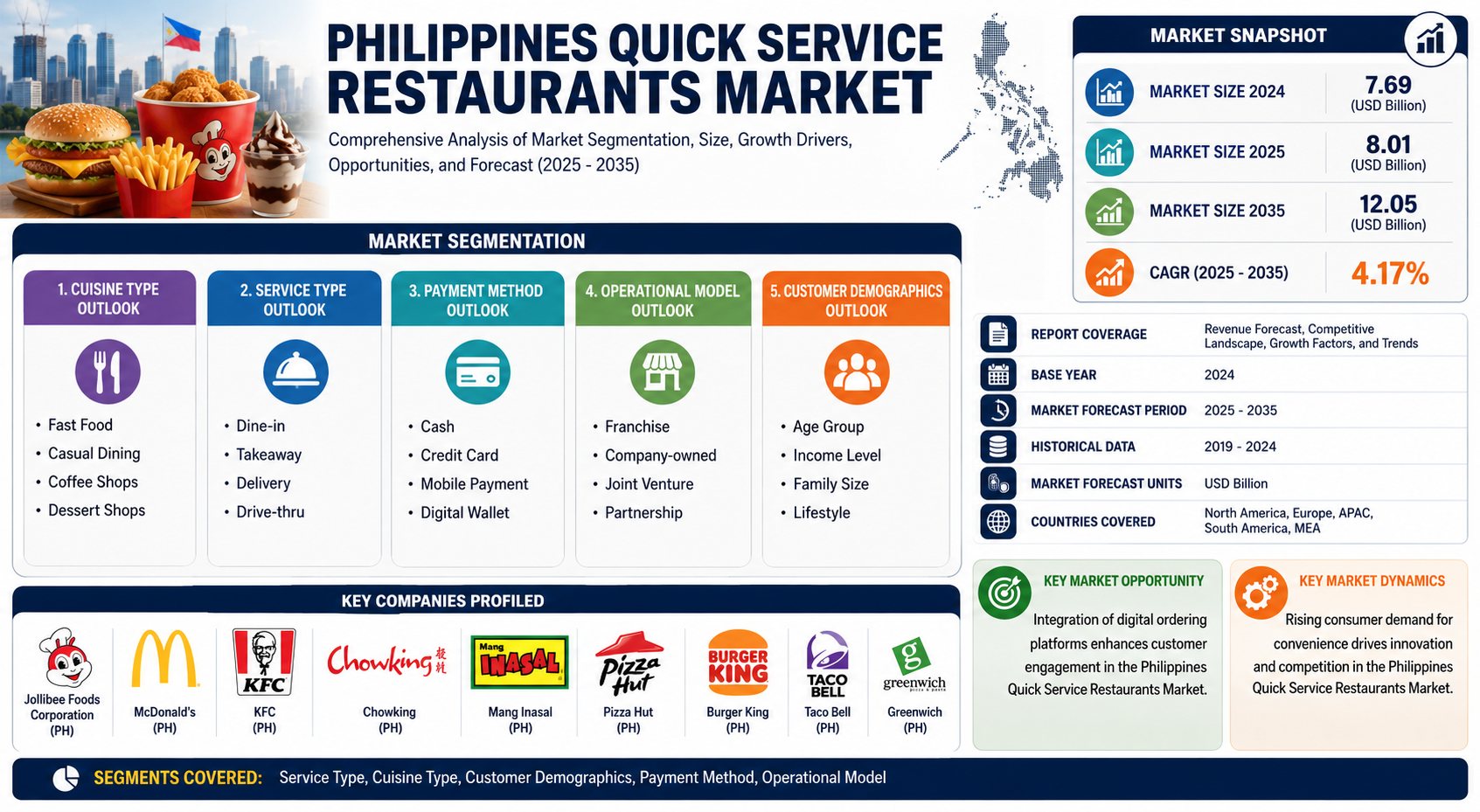
NEW YORK, NY, UNITED STATES, June 23, 2026 /EINPresswire.com/ — The Philippines Quick Service Restaurants (QSR) Market is witnessing steady expansion as shifting consumer lifestyles, urbanization, and digital transformation continue to reshape the country’s food service industry. According to the latest industry analysis published by Market Research Future, the market is projected to grow from USD 8.01 billion in 2025 to USD 12.05 billion by 2035, registering a compound annual growth rate (CAGR) of 4.17% during the forecast period.
The market was valued at USD 7.69 billion in 2024, supported by strong domestic demand, an expanding middle-income population, and the deep cultural integration of fast food and casual dining across urban and semi-urban regions. Increasing reliance on convenience-driven dining options, coupled with aggressive expansion strategies by leading restaurant chains, continues to strengthen the sector’s long-term growth outlook.
Key Market Drivers and Growth Opportunities
The Philippines QSR market is primarily driven by rapid urbanization, rising disposable incomes, and a clear shift in consumer behavior toward fast, affordable, and highly convenient dining options. As more Filipinos adopt busier work schedules and mobile-first lifestyles, quick service restaurants are increasingly becoming the preferred choice for everyday meals, snacks, and on-the-go food purchases.
One of the most significant growth opportunities lies in the integration of digital ordering platforms. Mobile apps, loyalty programs, and AI-driven recommendation systems are helping restaurant operators create more personalized customer experiences while also improving order accuracy, speeding up service, and strengthening repeat purchases. These digital tools are also enabling brands to better understand consumer preferences, optimize promotions, and streamline operations across dine-in, takeaway, and delivery channels.
Expansion into secondary cities and emerging urban centers also presents strong growth potential, as ongoing infrastructure development, improving transportation networks, and rising consumer spending power are creating new demand corridors beyond major metropolitan areas. As retail development spreads into provincial hubs and suburban communities, QSR operators have greater opportunities to reach untapped customer segments and establish a stronger nationwide presence.
Additionally, menu innovation, localized food offerings, and health-conscious product development are expected to play an important role in shaping future market trends. Brands that introduce regionally inspired flavors, value-driven meal bundles, and healthier alternatives are likely to appeal to a broader consumer base, particularly younger diners and families seeking variety, affordability, and better-for-you choices.
Get Full PDF Sample Copy of Report: (Including Full TOC, List of Tables & Figures, Chart) @ https://www.marketresearchfuture.com/sample_request/10874
Changing Consumer Lifestyles Fueling QSR Expansion
The growth of the Philippines Quick Service Restaurants Market is strongly tied to evolving consumer behavior. Busy urban lifestyles, longer working hours, and increasing participation of dual-income households have significantly increased demand for fast, affordable, and accessible dining options.
Quick service restaurants are becoming the preferred choice for consumers who value speed, consistency, and affordability. Traditional sit-down dining is gradually being supplemented by takeaway and delivery-focused consumption patterns, particularly in metropolitan areas such as Metro Manila, Cebu, and Davao.
Younger consumers, especially millennials and Gen Z populations, are playing a major role in shaping demand trends. Their preference for mobile ordering, food delivery apps, and digital payment systems is accelerating the transformation of the restaurant ecosystem toward a more technology-enabled model.
Digital Ordering Platforms Reshaping Food Service Delivery
One of the most significant trends influencing the Philippines QSR market is the rapid integration of digital ordering platforms. Mobile applications, third-party food delivery services, and restaurant-owned digital ecosystems are transforming how customers interact with food service providers.
Consumers now expect seamless ordering experiences, real-time tracking, digital promotions, and multiple payment options. This shift has encouraged major QSR brands to invest heavily in digital infrastructure, loyalty programs, and app-based ordering systems.
The integration of delivery platforms has also expanded the reach of QSR brands beyond physical store locations, allowing them to serve customers in residential neighborhoods, office districts, and suburban areas more efficiently.
Industry analysts highlight that digital convenience is no longer a value-added feature but a core requirement for competitive positioning in the Philippine food service market.
Fast Food Segment Dominates Cuisine Type Landscape
Within the cuisine type segmentation, fast food continues to dominate the Philippines Quick Service Restaurants Market. Burgers, fried chicken, rice meals, and localized fast food offerings remain highly popular due to affordability and familiarity among Filipino consumers.
However, casual dining formats are also gaining traction as consumers seek slightly elevated dining experiences without significantly higher costs. Coffee shops and dessert outlets are expanding rapidly, driven by rising café culture, social media influence, and increasing demand for experiential dining environments.
Coffee shops in particular have become lifestyle hubs for students, remote workers, and young professionals. These establishments are not only food and beverage providers but also social spaces that support informal meetings, studying, and leisure activities.
Dessert shops are also experiencing strong demand growth, supported by the popularity of milk tea, pastries, and localized sweet offerings that appeal to younger demographics.
Service Type Evolution Driven by Convenience Expectations
The service type segmentation of the QSR market reflects a clear shift toward convenience-driven consumption.
Takeaway services remain a foundational component of the industry, particularly in high-density urban areas where consumers prefer quick food pickup during work breaks or commuting hours. Dine-in services continue to hold importance, especially in established restaurant chains that emphasize brand experience and customer engagement.
However, delivery services represent one of the fastest-growing segments in the Philippines QSR landscape. The expansion of food delivery platforms, improved logistics networks, and increased smartphone penetration have made home delivery a mainstream consumption channel.
Drive-thru services are also gaining popularity, particularly in suburban and highway locations where convenience and speed are key priorities. Many global and local chains are expanding drive-thru infrastructure to capture time-sensitive customers and improve operational efficiency.
Payment Method Transformation Accelerates Digital Adoption
The Philippines QSR market is undergoing a significant transformation in payment methods, reflecting broader financial digitization trends in the country.
Cash payments remain widely used, particularly among traditional consumers and in smaller urban centers. However, digital wallets, credit cards, and mobile payment systems are rapidly gaining adoption, especially among younger and urban populations.
Digital wallet usage has surged due to the expansion of fintech platforms and government-led financial inclusion initiatives. QR-based payments, app-integrated checkout systems, and contactless transactions are becoming increasingly common in QSR outlets.
Credit and debit card usage continues to grow steadily, particularly in chain restaurants and shopping mall-based food courts. As digital financial infrastructure continues to expand, the shift toward cashless transactions is expected to accelerate further over the forecast period.
Franchise Model Dominates Operational Structure
The operational structure of the Philippines Quick Service Restaurants Market is heavily dominated by franchise-based models. International brands and local chains rely on franchising to expand their footprint across the archipelago efficiently.
Franchising enables rapid expansion with lower capital risk, while maintaining standardized quality and brand consistency. This model has been particularly successful in the Philippines due to strong entrepreneurial participation and high consumer brand loyalty.
Company-owned stores continue to play an important role, particularly in flagship locations and high-traffic urban centers. These outlets allow brands to maintain direct control over operations, service quality, and customer experience.
Joint ventures and partnerships are also emerging as strategic approaches for market expansion, especially for international brands seeking local expertise and regulatory navigation. These collaborative models help accelerate market entry while reducing operational risks.
Customer Demographics Drive Market Diversification
Customer segmentation in the QSR market reflects the diverse nature of Philippine consumer behavior.
Age groups play a major role in shaping consumption patterns, with younger demographics driving demand for fast food, digital ordering, and trendy café experiences. Older consumers tend to prefer traditional fast food formats and dine-in experiences.
Income levels also influence purchasing behavior, with middle-income consumers forming the core customer base for most QSR brands. Affordable pricing and value meal offerings remain critical in maintaining strong market penetration.
Family size is another important factor, as group dining and bundled meal offerings are widely popular among Filipino households. Many QSR chains design family-oriented meal packages to cater to this segment.
Lifestyle preferences, including work schedules, mobility patterns, and social habits, further influence customer engagement across different QSR formats.
Competitive Landscape Strengthened by Established Brands
The Philippines Quick Service Restaurants Market is highly competitive, with both global and domestic brands playing a significant role in shaping industry dynamics.
Key companies operating in the market include:
• Jollibee Foods Corporation (Philippines)
• McDonald’s (Philippines)
• KFC (Philippines)
• Chowking (Philippines)
• Mang Inasal (Philippines)
• Pizza Hut (Philippines)
• Burger King (Philippines)
• Taco Bell (Philippines)
• Greenwich (Philippines)
Jollibee Foods Corporation continues to maintain a dominant position in the local market, supported by strong brand identity, extensive store networks, and deep cultural integration within Filipino dining habits.
Global brands such as McDonald’s and KFC continue to compete aggressively through menu localization, promotional campaigns, and digital engagement strategies.
Market Challenges and Operational Constraints
Despite strong growth prospects, the market faces several challenges. Rising operational costs, supply chain disruptions, and intense competition can impact profit margins for operators.
Labor shortages in the food service industry and fluctuating food ingredient prices also present operational challenges. Additionally, maintaining consistency in service quality across franchise networks remains a key concern for large chains.
However, continuous investment in technology, automation, and supply chain optimization is helping mitigate some of these pressures.
Future Outlook
The Philippines Quick Service Restaurants Market is expected to maintain steady growth over the forecast period, supported by evolving consumer behavior, digital transformation, and expanding franchise networks.
By 2035, the market is projected to reach USD 12.05 billion, driven by sustained demand for convenient, affordable, and digitally enabled dining experiences.
As technology continues to reshape the food service industry, QSR operators in the Philippines are likely to focus on innovation, customer experience enhancement, and operational efficiency to maintain competitiveness in a rapidly evolving marketplace
Discover Related Research Reports By Market Research Future:
Quick Service Restaurants (QSR) Market
https://www.marketresearchfuture.com/reports/quick-service-restaurants-qsr-market-10541
Beach Hotels Market
https://www.marketresearchfuture.com/reports/beach-hotels-market-24111
Casino Hotel Market
https://www.marketresearchfuture.com/reports/casino-hotel-market-24538
Sagar Kadam
Market Research Future
+1 628-258-0071
email us here
Visit us on social media:
LinkedIn
Facebook
X
Legal Disclaimer:
EIN Presswire provides this news content “as is” without warranty of any kind. We do not accept any responsibility or liability
for the accuracy, content, images, videos, licenses, completeness, legality, or reliability of the information contained in this
article. If you have any complaints or copyright issues related to this article, kindly contact the author above.

Media gallery