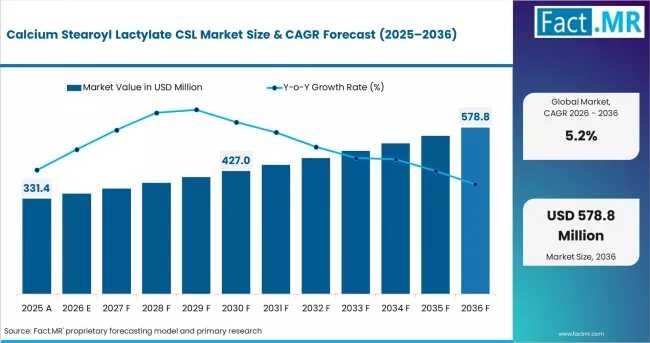
The Calcium Stearoyl Lactylate CSL Market is segmented by Application (Bakery Products, Dairy Products, Processed Foods, Confectionery Products)
ROCKVILLE, MD, UNITED STATES, April 14, 2026 /EINPresswire.com/ — According to Fact.MR’s latest analysis, the Germany calcium stearoyl lactylate (CSL) market is valued at approximately USD 24.5 million in 2025, projected to reach USD 26.0 million in 2026, and forecast to grow to USD 44.5 million by 2036. The market is expected to expand at a CAGR of 5.5%, generating an incremental opportunity of around USD 18.5 million over the forecast period.
The market is undergoing gradual transformation driven by industrial bakery standardization, processed food expansion, and formulation consistency requirements. CSL continues to play a critical role as a functional emulsifier and dough strengthener, enabling uniform texture, improved shelf life, and scalable food manufacturing processes across Germany’s highly regulated food industry.
Get detailed market forecasts, competitive benchmarking, and pricing trends:
https://www.factmr.com/connectus/sample?flag=S&rep_id=14709
Quick Stats
Market Size (2025): USD 24.5 Million
Market Size (2026): USD 26.0 Million
Forecast Value (2036): USD 44.5 Million
CAGR (2026–2036): 5.5%
Incremental Opportunity: ~USD 18.5 Million
Leading Segment: Food processing industry (78% share)
Leading Application: Bakery products (61% share)
Leading Function: Emulsifier & dough strengthener
Key Players: Corbion NV, Cargill Incorporated, Kerry Group Plc, ADM, Ingredion Incorporated
Executive Insight for Decision Makers
Germany’s CSL market reflects a performance-driven ingredient ecosystem, where consistency and regulatory compliance outweigh rapid innovation.
Strategic Shift: Transition toward multi-functional and clean-label-compatible emulsifiers
What Industry Must Do:
Maintain high functional consistency in emulsification performance
Strengthen supply reliability aligned with industrial bakery demand
Monitor clean-label substitution trends (enzymes, natural emulsifiers)
Risk of Inaction:
Loss of relevance due to clean-label reformulation pressures
Reduced adoption in premium bakery segments
Margin pressure from alternative ingredient systems
Market Dynamics
Key Growth Drivers
Stable demand from industrial bakery production
Increasing consumption of processed and packaged foods
Requirement for texture uniformity and shelf stability
Strong regulatory framework supporting standardized food additives
Key Restraints
Growing shift toward clean-label and additive-free formulations
Competition from enzyme-based dough conditioners
Price sensitivity in bulk food ingredient procurement
Emerging Trends
Development of hybrid emulsifier systems
Increased focus on label transparency and natural ingredients
Expansion of high-performance bakery formulations
Optimization of ingredient functionality for industrial-scale production
Segment Analysis
Leading Segment:
Food processing industry (78%), driven by large-scale ingredient usage
Fastest-Growing Segment:
Processed food applications beyond bakery, including dairy and ready meals
By Application:
Bakery dominates (61%)
Processed foods and dairy emerging
By Function:
Emulsification and dough strengthening remain core functions
Strategic Importance:
CSL ensures process efficiency, product consistency, and scalability, making it indispensable for Germany’s industrial food manufacturers.
Supply Chain Analysis (Critical Insight)
Raw Material Suppliers:
Fatty acids (vegetable oils)
Lactic acid (fermentation-based inputs)
Ingredient Manufacturers:
Chemical and food ingredient companies producing CSL through esterification processes
Distributors & Formulators:
Ingredient distributors supplying to food manufacturers
Food formulation specialists integrating CSL into recipes
Food Manufacturers:
Industrial bakeries
Processed food producers
Dairy and packaged food companies
End-Users:
Retail consumers via packaged food products
Foodservice sector
Who Supplies Whom:
Agricultural processors → CSL manufacturers → Ingredient distributors → Food processors → Retail & foodservice
Germany’s supply chain is highly structured, ensuring consistent ingredient quality and regulatory compliance.
Pricing Trends
Commodity vs Premium:
CSL operates in a mid-value functional ingredient segment
Premium pricing applies to high-performance and specialty formulations
Key Influencing Factors:
Raw material costs (vegetable oils, lactic acid)
Regulatory compliance requirements
Volume demand from bakery manufacturers
Functional performance consistency
Margin Insights:
Moderate margins in bulk supply
Higher margins in customized and specialty emulsifier blends
Regional Analysis (Germany Focus with Benchmarking)
Top Countries by CAGR
United Kingdom – 5.8%
Germany – 5.5%
United States – 5.2%
France – 5.0%
Japan – 4.6%
Germany Growth Drivers
Strong industrial bakery and food processing sector
Advanced food safety and additive regulation framework
High demand for consistent product quality
Developed vs Emerging Markets
Germany: Focus on quality, compliance, and formulation stability
Emerging markets: Focus on volume growth and cost efficiency
Competitive Landscape
Market Structure: Moderately consolidated
Key Players
Corbion NV
Cargill Incorporated
Kerry Group Plc
Archer Daniels Midland Company
Ingredion Incorporated
Palsgaard AS
DuPont Nutrition & Biosciences
Tate & Lyle Plc
Sternchemie GmbH
Wilmar International Ltd
Competitive Strategies
Product innovation in functional emulsifier systems
Expansion of global distribution networks
Focus on regulatory compliance and quality assurance
Development of clean-label alternatives
Strategic Takeaways
For Manufacturers
Focus on functional performance and consistency
Invest in clean-label compatible formulations
For Investors
Stable returns from mature but resilient ingredient market
Opportunities in value-added emulsifier solutions
For Distributors
Strengthen relationships with industrial bakeries
Offer customized formulation support
Future Outlook
Germany’s CSL market is expected to maintain steady growth with incremental innovation, characterized by:
Continued dominance of industrial bakery applications
Gradual shift toward clean-label and multifunctional ingredients
Increased emphasis on sustainability and sourcing transparency
Long-term opportunity lies in balancing functionality with consumer-driven clean-label trends.
Conclusion
The Germany calcium stearoyl lactylate market represents a stable, performance-driven segment within the food ingredient industry. Companies that prioritize consistency, compliance, and formulation adaptability will sustain competitive advantage in this evolving market.
Why This Market Matters
CSL remains a critical enabler of large-scale food production, ensuring consistent quality, extended shelf life, and efficient processing—key pillars of Germany’s advanced food manufacturing ecosystem.
Full Report: Unlock 360° insights for strategic decision making and investment planning-
https://www.factmr.com/checkout/14709
To View Related Report:
Calcium-Fortified Food Industry Analysis in the UK https://www.factmr.com/report/united-kingdom-calcium-fortified-food-industry-analysis
Calcium-Fortified Food Market https://www.factmr.com/report/1528/calcium-fortified-food-market
Calcium Salts Market https://www.factmr.com/report/calcium-salts-market
Calcium fortified juice Market https://www.factmr.com/report/1518/calcium-fortified-juice-market
S. N. Jha
Fact.MR
+1 628-251-1583
email us here
Legal Disclaimer:
EIN Presswire provides this news content “as is” without warranty of any kind. We do not accept any responsibility or liability
for the accuracy, content, images, videos, licenses, completeness, legality, or reliability of the information contained in this
article. If you have any complaints or copyright issues related to this article, kindly contact the author above.

Media gallery