

Jiangmen, Guangdong, China – November 23, 2026
Soap dispensers? They come in all sorts of styles, honestly. The best one really depends on where you’re planning to put it and how much use it’ll get. For a bathroom sink, a little countertop pump works great. But if you’ve got a busy kitchen sink, maybe go with a wall-mounted one—it keeps the counter clear. And manual ones? Can’t beat them for simplicity. Easy to use, easy to refill. You know those automatic soap dispensers? They basically squirt soap when your hand gets close to the sensor, which means fewer shared surfaces for everyone to touch. The downside? They still need batteries or an outlet nearby to keep running.Alright, so this guide goes over the common types of dispensers you’ll run into—pump, wall-mounted, touch-free, refillable, cartridge-based, that sort of thing. We also look at practical stuff like capacity, what soaps work, how easy it is to clean, and whether refilling is a pain. And honestly, those little details matter more than you’d think. You might find a dispenser that looks perfect, but then it’s awkward to refill or a hassle to clean around. Plus, the categories aren’t always clean-cut—some countertop ones have sensors, and some wall-mounted ones are manual pump. So yeah, worth checking before you commit.Honestly, picking the right soap dispenser isn’t about finding some universally “best” one. It’s really about matching it to where it’s going. Like, a busy public washroom? You probably want something with a bigger reservoir and easy upkeep. But a guest bathroom? A small, no-fuss design might be all you need. Of course, things like installation setup, what users prefer, and even the kind of soap you’re using all play a role. Product manuals are helpful, but at the end of the day, real-world fit is what counts. You can have a dispenser that looks great, but if the soap’s not right for it, it’ll still drip or clog on you. Alright, so the next few sections are going to compare these options, and I’ll also walk you through what to look for before you make your pick.

How Soap Dispensers Are Classified
Soap dispensers are commonly classified by how they operate, where they are installed, and which refills they accept. These categories can overlap: a wall-mounted model may also be touch-free. That matters.
Manual dispensers use a push button or lever, while automatic models release soap when a sensor detects a hand. Sensor units reduce shared contact, but low batteries, poor sensor placement, or splashes can affect performance. A dispenser that releases too little soap may prompt repeated use.
Mounting offers another distinction: countertop models sit beside a sink, wall-mounted units free up basin space, and recessed designs fit into a wall or counter.
Refill systems generally use either bulk-fill reservoirs or sealed cartridges. Bulk-fill units can reduce packaging, though they need regular cleaning to prevent residue. Cartridge systems are easy to replace, but require compatible refills. Soap type matters, too. Liquid soap, foam soap, and thicker formulas may need different pumps or nozzles, so they are not always interchangeable. When comparing products, check capacity, refill method, power source, and dose per activation. The phrase automatic soap dispensers manufacturer may appear in sourcing searches, but these practical categories help match a dispenser to its setting.
Manual Soap Dispensers
Manual soap dispensers release soap through a hand-operated pump, push button, or long lever. They need no batteries or electrical connection, making them practical in kitchens, workshops, and washrooms with steady foot traffic. A lever can also be easier to press with an elbow when hands are visibly soiled. Simple, but not maintenance-free.
The Centers for Disease Control and Prevention reports that handwashing with soap may reduce diarrheal illness by 23–40% and respiratory illness by 16–21%. These figures describe handwashing, not a particular dispenser. Still, keeping soap accessible matters. Choose a dispenser with a clearly visible fill level and a refill opening staff can reach without removing the whole unit. Check that the pump delivers a consistent amount; too little soap may frustrate users, while excess can drip onto the sink.
Manual units do have a shared touchpoint. Regularly clean the pump and surrounding surface, and refill the container according to its instructions rather than topping it up blindly. That small shortcut can leave old residue behind. For facility buyers comparing options, an automatic soap dispensers supplier may also provide manual models; ask about mounting height, replacement parts, and refill compatibility before ordering. A dispenser that is awkward to refill often gets neglected.
Automatic and Touchless Soap Dispensers
Automatic and touchless soap dispensers release soap when a hand enters the sensor’s range. Users do not need to press a shared pump. Less contact helps. These dispensers suit busy kitchens, clinics, and washrooms, where several people may use the same sink. Many models run on batteries or rechargeable power, so check the power requirements before choosing one.
Sensor placement matters. A dispenser set too close to a tap or shiny surface may activate unexpectedly; one set too far away can feel slow. Not ideal. Match the dispenser to the soap it supports, since thick formulas may not flow smoothly through every mechanism. Check refill access and how easily the housing opens, too. Small details matter.
Wipe the sensor window and nozzle regularly to remove soap film and water spots. In shared spaces, a clear indicator for low soap or battery power can prevent awkward empty-dispense moments. Touchless does not mean maintenance-free. It is easy to assume the sensor will solve every hygiene concern, but users still need enough soap and time to wash thoroughly. The convenience is real, though the fit and upkeep deserve a little thought.
Countertop and Freestanding Soap Dispensers
Countertop soap dispensers sit beside a sink, keeping soap within reach without using floor space. They work well in compact bathrooms, powder rooms, and kitchens with a clear, level surface. A refillable pump bottle is easy to check, while a touch-free model can reduce shared contact. Check that the base stays steady and the pump clears the basin when pressed. Small detail, big difference.Freestanding dispensers are not fixed into a wall or sink. Compact versions can stand on a vanity or shelf; taller units suit larger wash areas where counter space is limited. Their placement can be changed without drilling, which helps when a room layout shifts. Capacity varies, so compare the refill volume with how often the sink is used. A large container may mean fewer refills, but it can look bulky in a small room.Product descriptions sometimes use “countertop” and “freestanding” interchangeably, since both may sit unattached on a surface. Check the dimensions, mounting method, and refill opening rather than relying on the label alone. Wipe around the base regularly, especially near a wet sink, and watch for soap buildup at the pump nozzle. Even a well-made dispenser can clog if residue is left to dry.
Wall-Mounted and Built-In Soap Dispensers
Wall-mounted soap dispensers attach to tile, glass, or another firm surface near the sink or shower. They keep bottles off the counter and make refills easy to see. Most models use a push button or a sensor, so choose an operation that suits the room’s users. Check the mounting surface and refill opening before buying; a dispenser placed too high can be awkward for children. Small detail, big difference.Built-in dispensers sit through a sink deck or countertop, leaving the basin area looking neat. A refill bottle usually sits underneath, so check that the cabinet has enough clearance and that the bottle is easy to reach. These units work well in busy kitchens, but installation may require a suitable hole and access below the counter. A sleek finish is appealing, though it is not always the easiest option to service.Tips: Measure the wall or counter space, then check the dispenser’s capacity and refill method. For shared bathrooms, pick a model with a visible level window. Compare the best automatic soap dispensers by sensor response and cleaning needs, not appearance alone. Test placement with a paper template first; even careful measuring can miss an inconvenient reach.
What Types of Soap Dispensers Are Available?
Typical mounting surfaces for wall-mounted and built-in soap dispensers
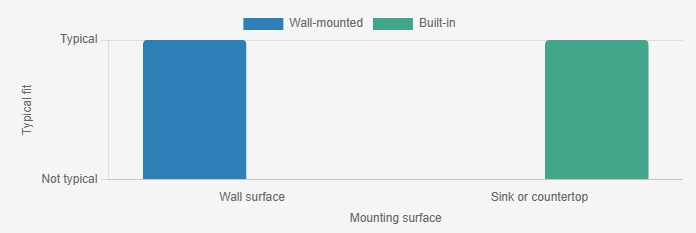
A value of 1 indicates the type’s usual mounting surface; 0 indicates it is not the typical fit. This is a categorical comparison, not market-share data. Specific installation requirements vary by model.
Dispensers for Liquid, Foam, and Powdered Soap
Soap dispensers generally handle liquid, foam, or powdered soap, and each format has different refill and cleaning needs. Liquid dispensers are familiar in kitchens and washrooms; their pumps suit thicker soap, but residue can collect around the nozzle. Foam dispensers mix soap with air, so a small dose creates a light lather. They can reduce how much soap each press releases, though the refill must match the dispenser’s foaming mechanism. Small details matter.
Powdered-soap dispensers are less common in homes, but they can suit workshops or facilities already using dry soap. Their container needs to stay dry, and the outlet should release a consistent portion without clumping. Check refill compatibility, placement, and whether parts can be rinsed easily. In daily use, a pump that sticks after a week is frustrating, even if it looked sturdy on day one. The best hand soap dispensers are not one type for every room: choose by soap format, traffic, and cleaning routine. I would still test the refill before buying several units.
Conclusion
Soap Dispensers come in several styles, each suited to different spaces and preferences. They can be classified by how they are operated, where they are installed, and the type of soap they hold. Manual models release soap when a pump or lever is pressed, while automatic, touchless models use a sensor to dispense soap without direct contact. Both options can work well in homes and shared spaces, depending on convenience and maintenance needs.In terms of placement, countertop and freestanding dispensers are easy to move and refill, while wall-mounted and built-in designs help save counter space and create a more integrated look. Dispensers also vary by the product they are designed to hold: liquid soap, foaming soap, or powdered soap. Choosing the right type means considering the available space, preferred operation, soap format, and how often the dispenser will need to be refilled or cleaned.
About Us
Established in 2010, Yingtao Sink. Is a professional manufacturer and exporter that is concerned with the design, development and production of Kitchen sink. We have 3 factories, which are located in Zhongshan City and Jiangmen City. with convenient transportation access.
Media Contact
Company Name: Jiangmen Yingtao Kitchen & Bathroom Co., Ltd.
Email: Send Email
Country: China
Website: https://www.gdyingtao.com/
Press Release Distributed by ABNewswire.com
To view the original version on ABNewswire visit: Industry Guide Explores the Various Types of Soap Dispensers Available on the Market Today
Media gallery
