The Business Research Company’s Commercial and Military Flight Simulation Global Market Report 2026 – Market Size, Trends, And Forecast 2026-2035
LONDON, GREATER LONDON, UNITED KINGDOM, October 19, 2026 /EINPresswire.com/ — The commercial and military flight simulation market has seen significant growth in recent years, reflecting the increasing reliance on simulated training environments for pilots. As aviation demands rise globally, the market is set to continue expanding, driven by advancements in technology and growing needs in both commercial and defense sectors. Let’s explore the current market size, key drivers, regional outlook, and emerging trends shaping this industry.
Projected Market Size and Growth Trajectory of the Commercial and Military Flight Simulation Market
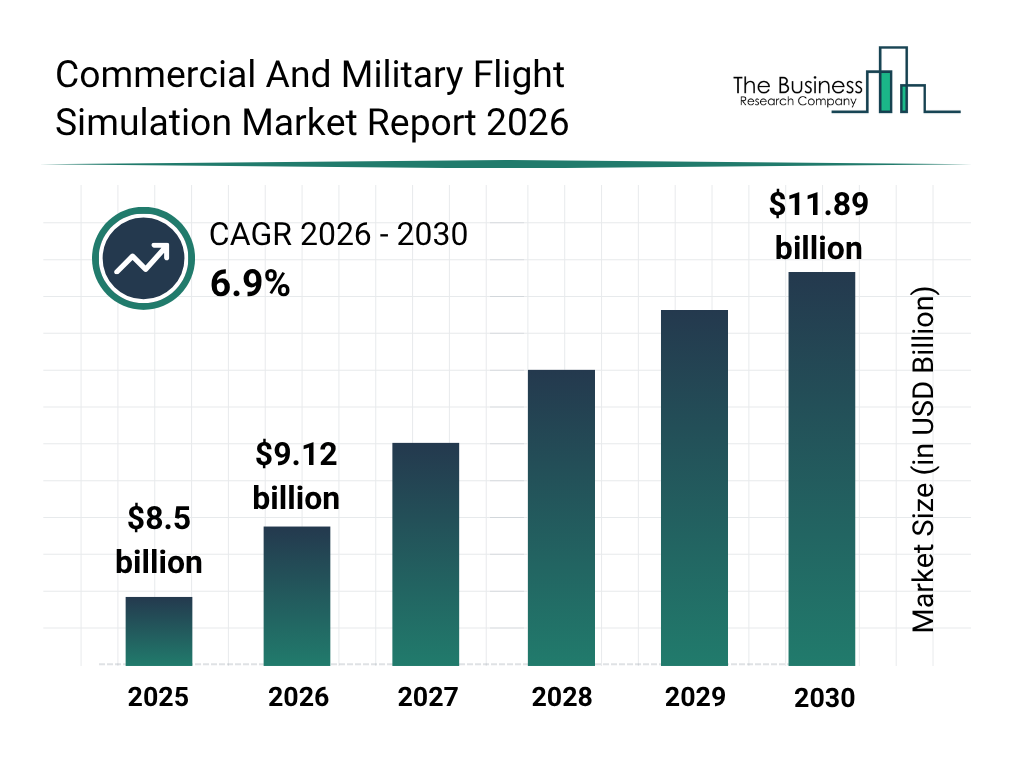
The commercial and military flight simulation market has experienced robust expansion and is expected to grow from $8.5 billion in 2025 to $9.12 billion in 2026, registering a compound annual growth rate (CAGR) of 7.3%. This earlier growth phase was largely influenced by increasing pilot training requirements in commercial aviation, heightened military pilot training activities, growing demand for flight safety programs, wider adoption of simulator-based certifications, and the expansion of aircraft fleets across the globe.
Download a free sample of the commercial and military flight simulation market report:
https://www.thebusinessresearchcompany.com/sample_request?id=89899768&type=smp&name=Commercial%20And%20Military%20Flight%20Simulation%20Market%20Report%202026&utm_source=EINPresswire&utm_medium=Paid&utm_campaign=Oct_PR
Looking ahead, the market is projected to maintain strong momentum, reaching $11.89 billion by 2030 with a CAGR of 6.9%. The anticipated growth drivers include rising demand for sophisticated pilot training systems, ongoing military modernization efforts, higher requirements for realistic mission simulations, the need to cut pilot training costs, and broader use of synthetic training environments. Key trends shaping the future landscape involve heightened demand for high-fidelity simulation systems, greater adoption of full-flight simulators in training, cost-effective virtual flight training solutions, expanded use of simulation for aircraft certification and testing, and increasing demand for mission-specific military simulation capabilities.
Understanding Commercial and Military Flight Simulation Technologies
Flight simulation in both commercial and military sectors involves the use of advanced software and hardware that replicate the operation of aircraft, accurate flight conditions, and mission scenarios in a controlled virtual setting. These simulations are essential tools for pilot training, certification processes, and safely assessing aircraft systems and flight procedures without the inherent risks and expenses of actual flight operations.
View the full commercial and military flight simulation market report:
https://www.thebusinessresearchcompany.com/report/commercial-and-military-flight-simulation-market-report?utm_source=EINPresswire&utm_medium=Paid&utm_campaign=Oct_PR
Primary Factors Propelling Growth in the Flight Simulation Market
One of the main catalysts driving the commercial and military flight simulation market is the steady increase in global air traffic. Air traffic encompasses the movement of aircraft carrying passengers, cargo, and military personnel through regulated airspace and airports. This growth is fueled by the rising demand for air travel as more people opt for air transport for both domestic and international journeys. The expansion of air traffic necessitates greater pilot training, ongoing certification, and operational readiness to ensure flight safety and efficiency amid growing aviation activity.
For instance, in January 2025, the International Air Transport Association (IATA), a Switzerland-based aviation trade organization, reported that global passenger traffic measured in revenue passenger kilometers grew by 10.4% in 2024 compared to the previous year. Additionally, international passenger traffic increased by 13.6% during the same period, with the overall passenger load factor reaching a record 83.5% in 2024. These statistics highlight how surging air traffic volumes are bolstering demand for flight simulation training systems worldwide.
Regional Market Leadership and Growth Patterns
In 2025, North America held the largest share of the commercial and military flight simulation market, reflecting the region’s advanced aviation infrastructure and significant defense investments. Meanwhile, the Asia-Pacific region is forecasted to be the fastest-growing market throughout the coming years, driven by expanding commercial aviation activities and military modernization across countries within this area.
The market analysis covers various key regions, including Asia-Pacific, South East Asia, Western Europe, Eastern Europe, North America, South America, the Middle East, and Africa, providing a comprehensive understanding of global market dynamics.
New strategic additions in our 2026 market reports include market attractiveness scoring and analysis, total addressable market (TAM) analysis, company scoring matrix graphics and tables, Excel-based forecasting dashboards, market hotspots infographics, key technologies and future trend analysis, along with updated graphics and tables.
Speak With Our Expert:
Saumya Sahay
Americas +1 310-496-7795
Asia +44 7882 955267 & +91 8897263534
Europe +44 7882 955267
Email: marketing@tbrc.info
The Business Research Company – www.thebusinessresearchcompany.com
Follow Us On:
• LinkedIn: https://in.linkedin.com/company/the-business-research-company“
Oliver Guirdham
The Business Research Company
+44 7882 955267
info@tbrc.info
Visit us on social media:
LinkedIn
Facebook
X
Legal Disclaimer:
EIN Presswire provides this news content “as is” without warranty of any kind. We do not accept any responsibility or liability
for the accuracy, content, images, videos, licenses, completeness, legality, or reliability of the information contained in this
article. If you have any complaints or copyright issues related to this article, kindly contact the author above.

Media gallery